Lapping Up Luxury at EXPO Chicago 2026

Once in a great while, it is possible for those of us far outside the one percent to brush up against a luxury lifestyle, to duck for a moment into a wealthy misting intended for some nearby, actual aristocrat. Maybe you’ve felt this while getting a lift home on someone’s PJ when the island hopper you were supposed to board needed new parts, or while following an invitation to a weekend at a location that does not appear on your Uber driver’s map. Or some such similar experience when you are suddenly plucked from the middle tier and placed temporarily at the top. These fleeting VIP moments can give the never-gonna-be wealthy among us an unexpected vertigo, a sudden grasp of the abstract measuring stick used to figure our worth in the world. It reveals the diminutive size of not just our means, but everything else in our orbit that we have come to appreciate.
This is the kind of staggering wealth international art fairs aim to attract and retain, and the kind that continues to fascinate fine artists across disciplines, regardless of their born-to backgrounds and current status of their stock portfolios. The 2026 EXPO Chicago was vast, as always, but what rose to the top of the galleries was the contemporary artist’s interpretation of luxury, play, and the ways we might return to a more analogue society without sacrificing these class stratifications. Being rich is in. Being broke is out. Being funny is sort of hanging in there, but being both rich and funny remains unrealistic.

I spent several hours making notes and taking pictures throughout EXPO Chicago, talking to gallerists and artists. But it has taken me more than a month to get this article written because the urge to contain the programming in a coherent thesis is strong but ultimately ridiculous. With 140+ booths to explore, it’s hard to digest and distill such a large showcase of globally diverse galleries and artists into any coherent observation on the state of visual art. (To do that, I’d need to quit my job, and as of this writing, I have not become wealthy enough to entertain this option.) My scope of EXPO 2026 was so limited. I could only attend for a short while on Friday, and did not attend dialogues on Contemporary Art in Historic Spaces, Poetics of Criticism, or Bodies as Technology, although I would have liked to. I did not participate in EXPO Art Week at satellite galleries, nor did I follow the exploratory city-wide itinerary outlining Faheem Majeed’s favorite haunts. I’ve already kicked myself for missing a performance by the brilliant jazz clarinetist Angel Bat Dawid. Darn this scant PTO!
What I missed of EXPO by disadvantage of living two hours north where I maintain a 9-5 is still a testament to the caliber of programming the EXPO team is able to assemble in the Midwest’s best city for the arts. You really need to immerse yourself and commit to the extended EXPO universe to grasp any cohesive underline. Although the majority of the event demonstrated outward-facing engagement with the contemporary, even when it seemed that what is contemporary is hardly pushing familiar boundaries, you gotta give the ritzy non-art types something to enjoy. Like the several Alex Alpert + Lexus activations that seemed intended to fool the audience into thinking such a commodity would be immune to standard vehicle depreciation. Good thing they stuck the indoor activation in the back, by the luxury IDF jewelry, so I wasn't tempted to linger.

Immediately to the left of the entrance, viewers encountered Adam Parker Smith’s Narcissist and Pool Float at Opa Projects. Narcissist in particular is visually magnetic–a balloon dolphin with mass-produced charm nose to nose with its own reflection. It’s silly as a concept and technically impressive as an object, but as far as conceptual depth, it is as shallow as the narcissist’s ability to self-criticize. If there’s one effect luxury has on everyone eventually, it’s an inflation of selfhood that coincides with a contraction from reality. Luxury smooths out the world, removes the textures and gradients that signify friction and age. In a way, the most luxurious lifestyles and luxuriating individuals have a mass-produced sheen to their world that implies perfection after much trial and error. But let’s be honest for a moment about the trials. Trials age our bodies and our souls. Who wants that?? Rich people do not.
The most immediate association between the Smith sculptures and the art world is Jeff Koons, whose balloon sculptures are polarizing emblems of artistic vanity and taste. Smith appears to make fun of this too in his portfolio, as if the artist is shaking hands with another, much more famous artist, and donning a knowing shit-eating grin all the while.

Trends aside, the quiet part of “quiet luxury” is beginning to turn up the volume. Maximalist luxury is coming back, baby! Just look at Terry Rodgers’ work at Wizard, where his Silent Memory depicts two men and two women in a mid-orgy rearrangement, exchanging lid-lowered suspicious glances at one another. They are all somewhat bound by their apparel–neckties and beaded necklaces, a boa and small brass details. Despite their jewels, and without their full garments, it is difficult to assess the status of the two women. In fact, this doubt can be equally extended to the young men. Anyone can rent a tux, and escorts are not always easy to spot. There is an air of confinement in the composition the same as there is in what remains of their clothing. Multiple sources of light play on bare, youthful skin, on the crystal cake dish on a glass-top table. Fragile glass and open flames lend the image a potent carelessness, perhaps more so than the reckless and rumpled state of the inebriated subjects. Even the light in the room seems drunk on dirty martinis. Beyond the jewelry, the lavish suite in which this scene takes place, the silk and stockings, isn’t reckless sex its own form of luxury, a different perspective on play? In Silent Memory, the equalizing question becomes “who’s objectifying who?”

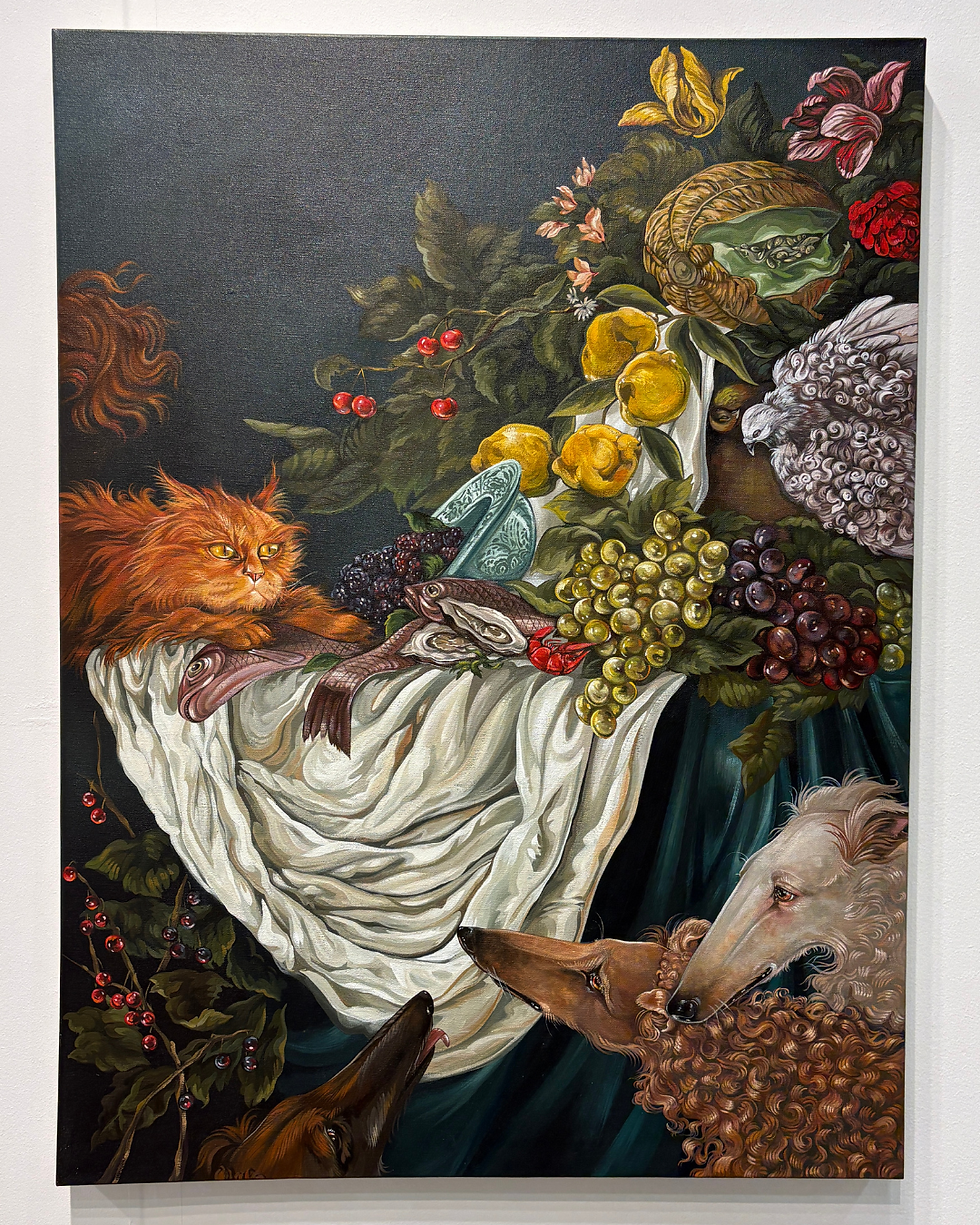
Similar is Sabrina Bockler’s Unruly, a still life with three Borzoi at the edge of a stacked feast, three pairs of begging eyes contemplate the draped tablecloth, certainly soaked in raw fish juices and fragrant with blackberry skins. Again we envision a reckless evening, as still lifes often evoke. The lumpen lemons tumble forth, the rising action in a swooping angle that concludes in folded magnolia. Composition wise, this painting is playful in its rumpled, curled arrangement, with liberties taken in the textures most decadent in still lifes. Bockler knows how far to push, lending the animals in the scene man-like expressions that reflect the mischief and wanting these arrangements tend to arouse.
On the other side of luxury, I saw a return to play, which is confined to no class, gender, race or religion. But even in playful depictions, something else is spoken underneath that explores and critiques our disconnection from others, our increased solipsism. Take Will Boone’s Bones at Karma as an example. On a flat green of table felt, dominoes are organized in a loose rendition of a human form, a skeletal suggestion using gameplay slang. Well, and what of the play itself? I have only a vague understanding of dominoes as a game, and a more advanced understanding (which is more like an “imaginative capacity” or “personal hallucination”) of artistic metaphor and simile. Two ones at the top of the composition stand in for a figure’s gaze, linked to a complex spine of sixes, hallow in the center near the gut, hinged by hip-like fives, and concluding in a balanced set of fours. Once you see the figure, you can interpret it multiple ways. Either the players have cooperated to construct a whole new individual from their collective play, or each player has laid down a bone in their own image, unconsciously edging forward their own portraiture. What does it mean that the limb on the right ends in a set of five spots, but the hand on the left is composed of a domino with a four and a one? Is the figure meant to hold one hand open and one in a point, index extended while the rest curl back? Does the asymmetry in the upper half indicate an injured shoulder or muscle loss at the elbow? Is this, in fact, a self portrait? Here, Boone begins to show his hand.

Play itself is surfacing after a period when art seemed to be taking itself too seriously. Sure, there are reasons aplenty to explore the XYZ diaspora, compounding post-globalization divisions, toxicities in feminine and masculine development under surveillance environments, etc. But as subject matter, galleries seemed to have set these and other heavy material aside for the exhibition. As we continue to use machines as mirrors for reality, more so now with the meteoric rise of you-know-what and its sudden appearance in the irreal reality of the digital universe, there is a rising analogue counterbalance that is making itself known. Artists are attempting to regain trust in our humanity and to fight for engagement with history and with each other, and it is the opinion of many that the professionally creative are the most qualified to lead the way. I felt this way while leaning in close to Chika Idu’s This is How We Meet and Julie Baker and Summer’s luminous series of women reading novels. Even under the same roof as a Lexus activation, something sincere pushed to the front of EXPO 2026. There is a clarion call pitching up in volume that cuts through the whooshing descent of our fall into dystopia, and that it is a new call for dreaming.

To be honest, I could have written about EXPO 2026 for a lot longer. But just like library books, you need to turn it in eventually. I will say that this year the event felt grounded, embedded fully into Chicago as a city and as a place with a real arts identity. I hope the exhibition never goes away or becomes corrupted by the wealthy in such a way that people on the outside take notice. For now, it is reasonable to accept that fairs like these are often a far cry from avant-garde, DIY, boundary-pushing spaces where the best work sometimes emerges, because they aren't funded by the uber-wealthy and morally bankrupt and can therefore live on the radical, beautiful edge of art until they are detected.
That's the problem though, don't you think?

Author notes: I did not only look at paintings. I just could not write about everything I observed without continuing to delay the release of this piece. These are the pieces that fit into a neat narrative, and I extend my apologies to the artists for not taking more professional photos. Part of Cormorant's unpolished charm, I hope.


Comments